
I am introducing a new spiritual discipline I’ve created for myself called Golgotha. It is a modified version of Misogi, a once‑a‑year, 50/50‑chance‑of‑success challenge with the tongue‑in‑cheek rule ‘don’t die’”, adapted to incorporate Christian reflection and prayer.
Earlier this week, I came across a podcast episode with a clickbait-y title, obviously intended to capitalize on the self-improvement aspirations that accompany the transition to a new year. It was this episode of the “My First Million” podcast: If you want a rich life, watch this before 2026.
I was skeptical, but I checked out the guest to see what kind of qualifications he had to grant the listener a “rich life”. The guest was Jesse Itzler, an entrepreneur, author, endurance athlete, and the creator of The Big Ass Calendar. I’m a sucker for niche productivity products, and I was intrigued by The Big Ass Calendar, so I went ahead and listened to the episode.
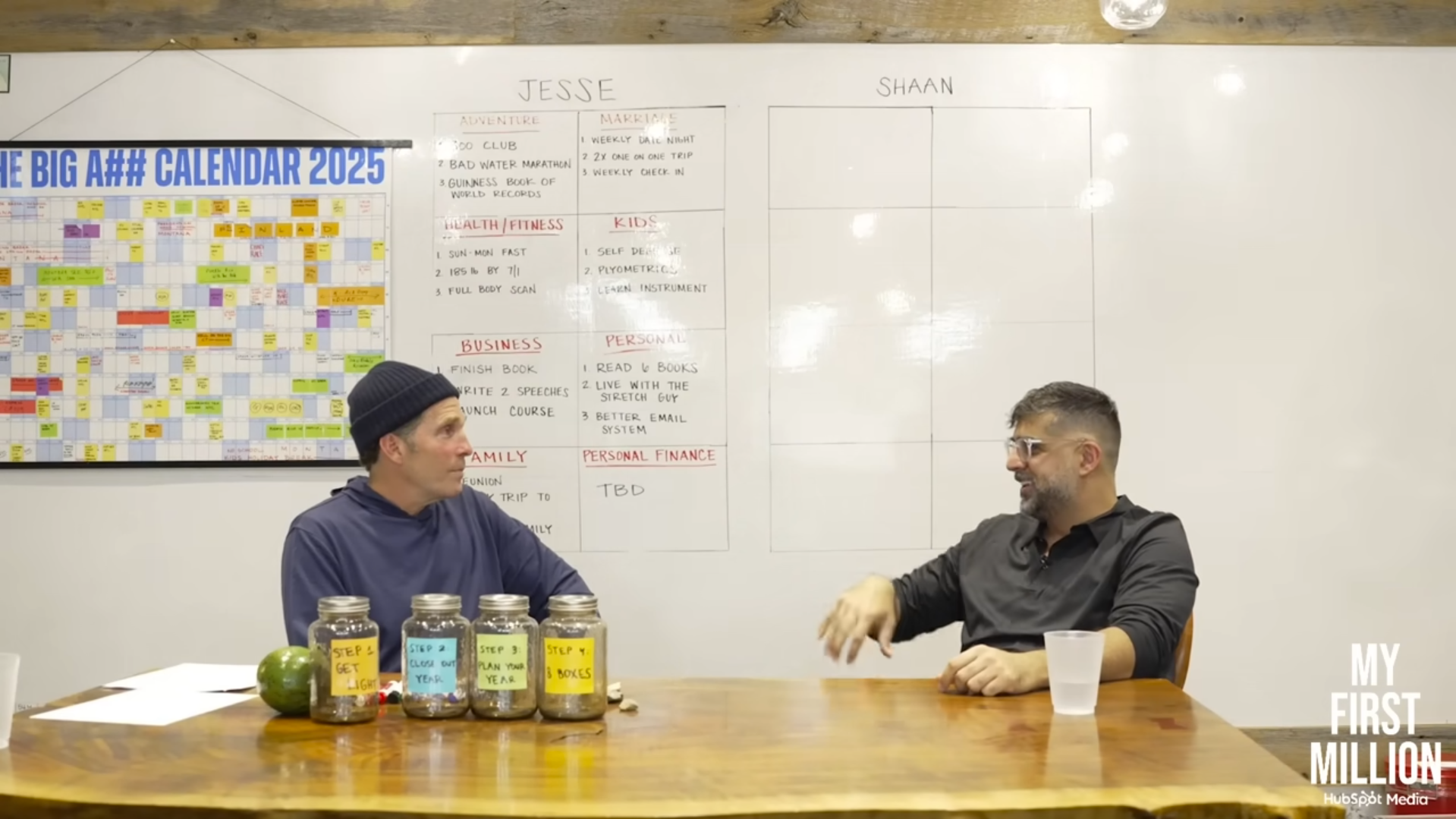
To my surprise, it was actually a fantastic episode and much less productivity-focused than I expected. I highly recommend you listen to it. Jesse shared some ideas I hadn’t heard before about how to intentionally plan out a year. I won’t regurgitate all the ideas he shared, but one in particular got lodged in my heart and had me all fired up.
It was the idea of scheduling one Misogi every year.
The concept is simple: one year-defining event each year that is really hard. Something you may not be able to accomplish. It is a beacon that guides your actions throughout the year, and something that could truly define your year in the sense that you could look back and say “2026 was the year of (insert deeply meaningful personal challenge)”. Now imagine being 80 years old and having 50+ Misogis that have shaped the person you’ve become and filled you with stories to pass on. That sounds like a rich life.
But something about the modern concept of Misogi didn’t sit right with me. The Japanese word “misogi” originally referred to a traditional Japanese purification ritual involving cold water immersion to cleanse the body, mind, and spirit. The modern, secular Misogi borrows the word but, as far as I can tell, does not meaningfully acknowledge the original spiritual practice it came from. It seems to strip the word of spirituality and replace it with a pseudo-spiritual self-enlightenment through difficulty.
I actually don’t think this is terrible, because doing hard things is noble and supports growth, but it feels lacking. That’s why I have adapted this discipline to restore the spiritual element and give it a new name:
Golgotha
What makes something a Golgotha?
A Golgotha, from the outside, appears nearly identical to a Misogi. It is a yearly commitment to do something so challenging that it can define that year. But internally, it incorporates additional practices of reflection and prayer.
Golgotha is a reference to “the place of the skull”, the hill outside of ancient Jerusalem where Jesus was crucified. I chose Golgotha as the name because this annual discipline is meant to point me back to the sacrifice that Jesus made at the cross. I know that any suffering I willingly undertake will be insignificant compared to what Jesus bore at the cross, but I want to to be reminded of what Jesus went through. This is not about adding to what Jesus finished on the cross, but it is about forming myself more into his image in obedience. It is a sort of annual communion: but instead of eating and drinking with Jesus, the aim is to carry a burden with him.
I am self-conscious of this becoming a shallow, thinly veiled, re-branded fitness goal, so I want to give the Golgotha some clear guardrails. Here is what I am starting with:
- It must be difficult enough that there is a real chance of failure.
- It must be chosen prayerfully. It must not just be for my ego.
- It must be sacrificial in a way that echoes the cross, whether that be comfort, time, pride or something else.
- It must push me to depend on God, not just on my own will.
A Golgotha is not meant to be an ego booster, but a reliance on God that forms me more into the likeness of Christ.
How the practice actually looks
Like many spiritual disciplines, Golgotha has an outer practice and an inner posture. On the outside it might look like training, planning, committing, or enduring. On the inside, it is meant to train my mind on Jesus' journey to the cross.
- There is a season of anticipation and preparation, like Jesus “setting his face to go to Jerusalem,” knowing where the road would lead.
- There is a Gethsemane moment, where the weight feels too heavy and the honest prayer is “Father, if you are willing, take this cup from me; yet not my will, but yours be done.”
- There is a kind of death: the point in the challenge where something in me has to die, such as my comfort, my image, or my illusion of control so that obedience can live.
The ordinary spiritual disciplines are woven through the preparation for my Golgotha: scripture, prayer, silence, journaling, worship. The Golgotha does not replace these disciplines, but focuses them in a time-bound season of obedience and dependence through difficulty. My aim is that this season will reframe my mindset away from typical comfort-seeking and push me further into the spiritual disciplines and reliance on God amid discomfort and difficulty.
Examples of possible Golgothas
A Golgotha could be physical, mental, spiritual, relational, or anything really, as long as it fits those criteria. Here are some examples I’ve considered:
- Training for and completing an endurance event far outside my current capability as an extended prayerful meditation on perseverance.
- Committing to an uncomfortably long silent retreat or pilgrimage to leave culture and wrestle with God.
- Taking on a daunting sacrificial service project, such as launching a ministry event or initiative.
Though my temptation will be to choose something that looks impressive, what really matters is that it pushes me to reflect Jesus' prayer in Gethsemane: “not my will, but yours be done.”
My 2026 Golgotha
For 2026, I’m feeling a lot of excitement toward a Golgotha that is both physically demanding and spiritually formative. I am looking for something that:
- Requires months of consistent, uncomfortable preparation.
- Forces me to confront my limits instead of working around them.
- Gives me plenty of space to pray the Gethsemane prayer: “yet not my will, but yours be done.”
While I don’t want to publicly announce my Golgotha, I’ve been shopping an idea around in conversation with family and friends. Most have been cautiously supportive, with one family member saying “I don’t think that’s such a good idea”. I was happy to receive that doubt though, because that’s a good sign that my Golgotha will be sufficiently difficult.
Despite the difficulty ahead, I’m really excited to start this discipline and I hope you are too! If Golgotha or Misogi are something that you choose to commit to in the new year due to this article, I would love to hear about it!
Also, a gentle reminder I’m saying to myself: if you try this, resist the urge to compare your Golgotha to anyone else’s. The point is not to match someone else’s hill, but to meet God on yours.
Wishing you love and health in 2026. Happy new year!